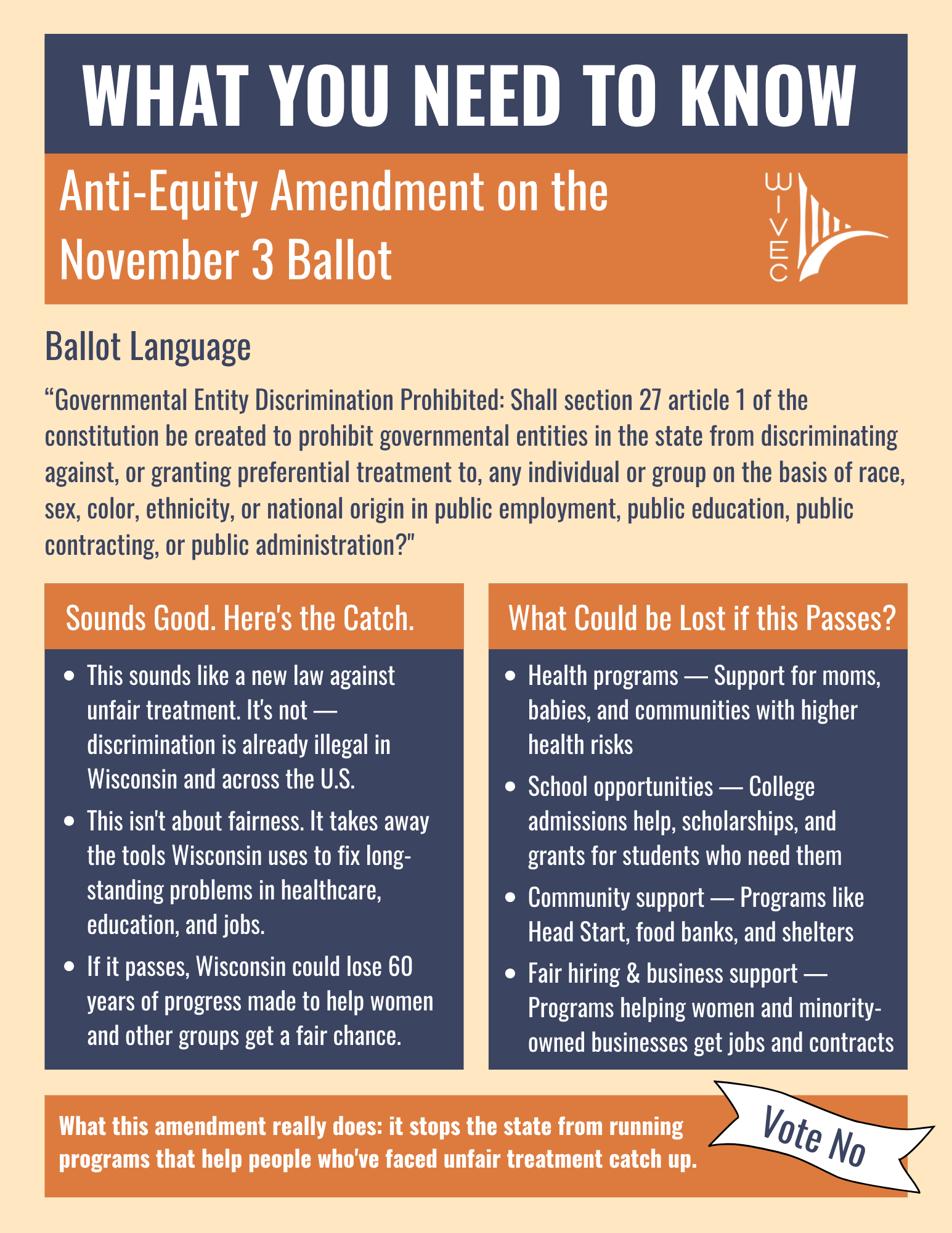
Question 3: Prohibiting Government from discrimination or “Granting Preferential Treatment” based on race, sex, color, ethnicity, or national origin.
Ballot question: “Governmental entity discrimination prohibited. Shall section 27 of article I of the constitution be created to prohibit governmental entities in the state from discriminating against, or granting preferential treatment to, any individual or group on the basis of race, sex, color, ethnicity, or national origin in public employment, public education, public contracting, or public administration??
Constitutional Amendment: Section 1. Section 27 of Article I of the Constitution is created to read:
[Article I] Section 27 (1) In this section, “governmental entity” means the state, its political subdivisions including municipalities, the University of Wisconsin System, the Technical College System, any public college or university, any public school district, and any office, department, independent agency, board, commission, authority, institution, association, society, or other body in state or local government created or authorized to be created by the constitution or any law, including the legislature and the courts.
(2) A governmental entity may not discriminate against, or grant preferential treatment to, any individual or group on the basis of race, sex, color, ethnicity, or national origin in public employment, public education, public contracting, or public administration.
(3) This section does not prohibit action that must be taken to establish or maintain eligibility for any federal program, if ineligibility would result in a loss of federal funds to the governmental entity.
(4) Nothing in this section prohibits bona fide qualifications based on sex that are reasonably necessary to the normal operation of public employment, public education, public contracting, or public administration.
(5) If any part or parts of this section are found to be in conflict with the United States Constitution or federal law, the section shall be implemented to the maximum extent that the United States Constitution and federal law permit. Any provision of this section held invalid shall be severable from the remaining portions of this section.
What does this mean?
What does this order do?
If passed, this amendment would bar the state and all local governments from utilizing race, sex, color, ethnicity, or national origin when determining policy provisions to address issues, disparities and inequities because “preferential treatment” is inserted in the Constitution.
For example, current long-standing programs in our state would be ruled unconstitutional like the Supplier Diversity Program, the Minority Retention Grant, and the Minority Teacher Loan Program.
These programs would also include education and business support opportunities for minorities and women.
Essentially, this amendment would allow entities to challenge funding provided directly to entities that support Wisconsinites who are women, LGBTQ+, or people of color. Meaning our state would be handcuffed from making surgical policy decisions to make lives better by barring us from making all considerations.
Information from Senator Dora Drake, 4th Senate District
A Reflection from an American Baptist on the Discrimination Amendment
Written by Rev. Mindi Welton-Mitchell, Executive Minister, American Baptist Churches of Wisconsin
When I first read this amendment, I must ask, “what is the actual question, and why is it worded this way?” The Wisconsin State Constitution already prohibits discrimination against any individual or group on the basis of race, sex, color, ethnicity, or national origin in public employment, public education, public contracting, or public administration under Article 1, Section 27. So the question is not actually about government entities discriminating, but about an assumption of preferential treatment.
Sometimes we assume that God’s justice means fairness. That everyone should be given exactly the same opportunity. However, when we look at Scripture, we find that God understands the world we live in is not fair and equal. That’s why we have Mary singing in her Magnificat, “He has brought down the powerful from their thrones and lifted up the lowly; he has filled the hungry with good things and sent the rich away empty” (Luke 1:52-53, NRSVUE). That sounds like great news if you are lowly and hungry, but if you are powerful and rich, does this sound like good news to you? Just a few chapters later, in Luke 4:18a, Jesus reads from Isaiah 61: “The Spirit of the Lord is upon me, because he has anointed me to bring good news to the poor.” Is there a note about good news for the rich, or did Jesus leave that out?
We do not read those passages as good news for only a small group of people, even though it’s specifically directed toward the poor and hungry; we understand that that good news for one group is good news for all of us. The hungry being filled with good things and the lowly being lifted up is good news for everyone. This is part of living into Christ’s kingdom on earth.
Helping an individual or group based on their identity as a historically marginalized people is away our whole society is lifted up. This is why we have had government entities to support accommodations for people with disabilities, to support healthcare initiatives and education for women of color, and to support diversity initiatives to ensure that people from a variety of backgrounds have the same opportunities as those from a majority background. This is also Scriptural. This is why there are multiple verses about the poor and the widow and the orphan in the Bible, which is Bible-speak for “the most vulnerable among you.” I encourage you to study the scriptures for mentions of the poor, the widow, or the orphan. What may appear as showing preferential treatment to one group is a Biblical way of promoting equity. Now think of the people in our greater society who are most vulnerable, who don’t have the same access to higher education, job support, and small business loans. If we were able to meet the needs of these people, won’t all of us benefit as a society from stronger businesses, workers, and families?
This is the good news that Mary sings about, for the lowly and the hungry, in praise of her Savior to be born. When we look to the most vulnerable among us and work to meet their needs, through our churches, communities, and through our government resources, we find that all of us are lifted up together.
Position: Oppose
What does ELCA social teaching say?
The ELCA’s social teaching emphasizes that “any use of power, whether in law, policy, or action” should extend God’s power for all people and groups. This is “especially important with respect to those who have been denied power historically or marginalized by social systems.” (Faith & Civic Life, p. 35). When considering proposed laws, one important question is: “Does it effectively rectify failures of the past, especially failures to include the marginalized?” (Faith & Civic Life, p. 43)
According to the ELCA’s social teaching, “racism—a mix of power, privilege, and prejudice—is sin, a violation of God’s intention for humanity. The resulting racial, ethnic, or cultural barriers deny the truth that all people are God’s creatures and, therefore, persons of dignity. Racism fractures and fragments both church and society” (Freed in Christ: Race, Ethnicity, and Culture, p. 4). “When we rebuild walls of hostility and live behind them—blaming others for the problem and looking to them for solutions—we ignore the role we ourselves play in the problem and also in the solution. When we confront racism and move toward fairness and justice in society, all of us benefit” (Freed in Christ, p. 4)
As the ELCA teaches, “the Church must cry out for justice, and thereby resist the cynicism fueled by visions that failed and dreams that died. The Church must insist on justice, and thereby refuse to blame victimized people for their situations. The Church must insist on justice, and thereby assure participation of all people.”(Freed in Christ, p. 5)
Excerpt from: A Voter Guide from the Lutheran Office of Public Policy in Wisconsin
The Lutheran Office for Public Policy in Wisconsin (LOPPW) represents the coordinated public policy witness of the Evangelical Lutheran Church in America (ELCA) and engages Lutherans in advocacy for policies that promote peace, justice, and care for all of God’s creation. As Lutherans, we believe that God calls us to serve our neighbors and provides mercy, hope, and joy through Jesus Christ. See the entire voter guide here.