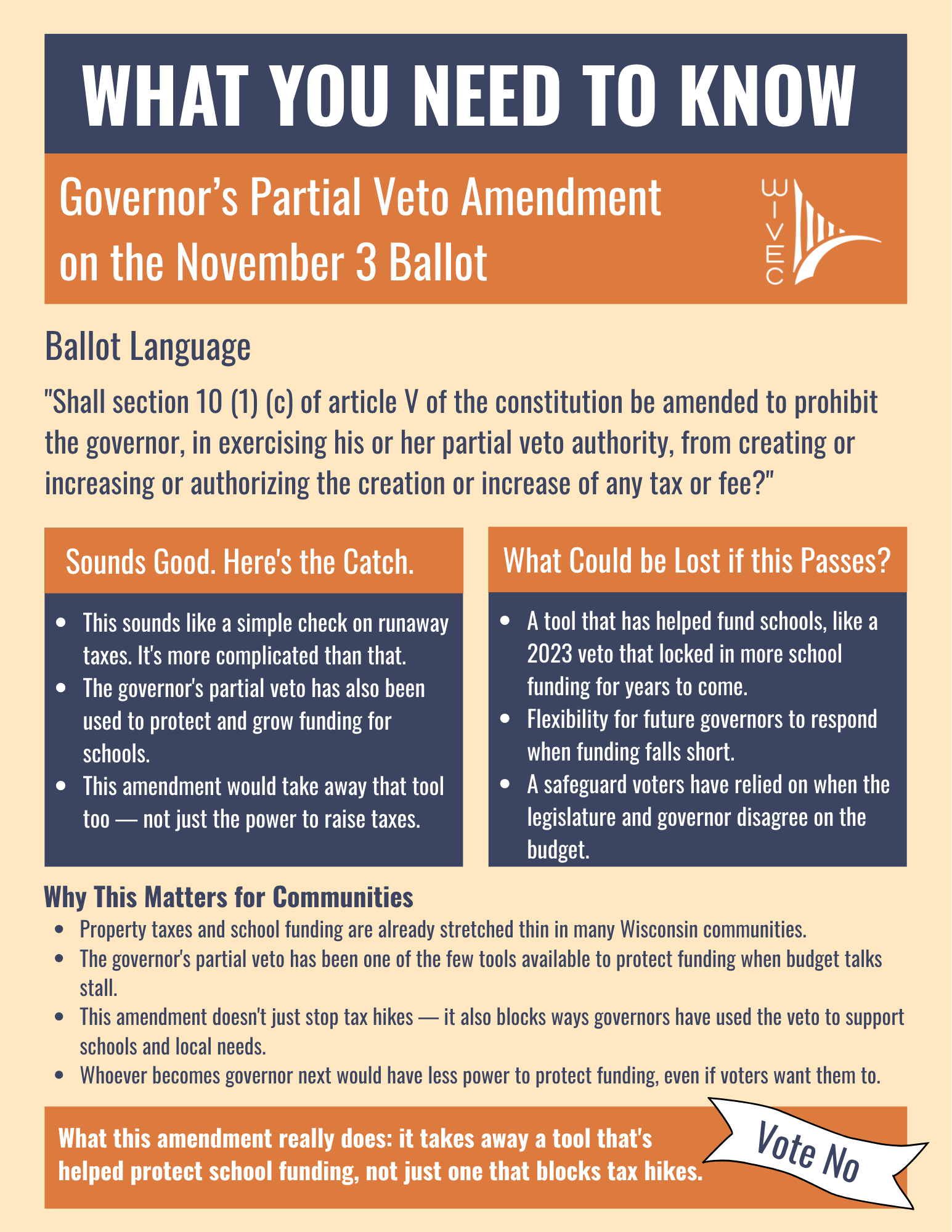
Question 1: Prohibit the Governor from using the partial veto to create or increase any tax or fee.
Ballot question: “Partial veto. Shall section 10 (1) (c) of article V of the constitution be amended to prohibit the governor, in exercising his or her partial veto authority, from creating or increasing or authorizing the creation or increase of any tax or fee?”
Constitutional Amendment: Section 1. Section 10 (1) (c) of Article V of the Constitution is amended to read:
[Article V] Section 10 (1) (c) In approving an appropriation bill in part, the governor may not create a new word by rejecting individual letters in the words of the enrolled bill, and may not create a new sentence by combining parts of 2 or more sentences of the enrolled bill, and may not create or increase or authorize the creation or increase of any tax or fee.
What does this mean?
In Wisconsin, our Governor has one of the most powerful veto pens in the country which allows whoever holds that office to strike nearly any part of a budget bill, including sentences, words, or even single characters or numbers
This amendment stems from the Governor’s veto in the 2023-2025 biennium budget where he crossed out a number in legislation to change the year and increase per-pupil funding for public schools for the next 400 years.
What does this order do?
● Right now Wis. Const. art. V, s. 10 (1): (b) says appropriation bills may be approved in whole or in part by the governor, and the part approved shall become law.
● If this amendment passes it would limit that specific previous section of the Constitution if it creates or increases any tax or fee. This would make a veto like Governor Evers did a couple years ago unconstitutional.
Information from Senator Dora Drake, 4th Senate District
Power as a Public Trust: A Reformed Reflection on Wisconsin’s Partial Veto Amendment
Written by Rev. Christian D. Boyd, DLitt, DMin, MBA
Wisconsin voters will be asked this November whether the state constitution should place another limit on the governor’s partial veto authority. The proposed amendment would provide that, when approving an appropriation bill in part, the governor “may not create or increase or authorize the creation or increase of any tax or fee” (Wisconsin Legislature). The referendum materials situate the proposal within Wisconsin’s long history of a broad gubernatorial partial veto and, more immediately, the controversy surrounding Governor Tony Evers’s 2023 use of that authority regarding public school funding (Fall Referendum 4-5).
The immediate question is constitutional, but constitutional questions are ultimately questions about the ordering of power. Who is entrusted to act? Where does that authority begin and end? How is it shared with others, and toward what purpose is it exercised?
For those of us in the Presbyterian Church (U.S.A.), within the wider Reformed family represented by the World Communion of Reformed Churches, the starting point is not whether we approve of the governor who presently exercises the power under consideration. Our tradition begins with the purpose of civil authority, the reality of human fallibility, and the conviction that power is entrusted for the public good.
The Westminster Confession speaks of civil government as ordered toward the “public good” and charges those exercising public authority with maintaining justice and peace (Presbyterian Church (U.S.A.) 6.127-28). The Confession of 1967 likewise declares that peace, justice, and freedom are goods that “all powers of government are called to serve and defend,” while economic resources are to be understood in relation to the “common welfare” (Presbyterian Church (U.S.A.) 9.45-46).
Neither confession tells Wisconsin how broad a governor’s partial veto should be. Confessions instead provide the Church with a theological framework through which Christians may examine public life. Political authority is not an end in itself. It is a form of stewardship.
The present proposal arises in part from Governor Evers’s 2023 use of the partial veto to alter language concerning school district revenue limits. By removing portions of the enacted language, a provision originally extending through the 2024-25 school year was changed so that the per-pupil revenue-limit increase continued through 2425. The proposed amendment would prohibit a future governor from using the partial veto to create or increase a tax or fee in a similar manner (Fall Referendum 4-5).
It would be easy to approach the referendum primarily as a judgment upon one governor. A constitution requires a longer view. Governors change. Legislatures change. Political parties gain power and lose it. Constitutional provisions remain long after the personalities and controversies that produced them have passed.
The Presbyterian and Reformed traditions of Christianity offer a useful discipline in this regard. We do not assume that political authority becomes righteous simply because someone we trust possesses it. Our theology takes human limitation and self-interest seriously. The Confession of 1967 reminds us that individuals and institutions remain entangled in sin even when pursuing causes they consider just (Presbyterian Church (U.S.A.) 9.13).
A useful question for Christian voters, therefore, is this: Would I still believe this power was appropriate if it were exercised by someone whose politics I strongly opposed?
Those who supported Governor Evers’s use of the veto should imagine the same authority exercised by a future governor pursuing policies they consider harmful. Those who opposed his action should ask whether they would continue to support this constitutional restriction if a future governor they favored believed such authority necessary.
The amendment also concerns taxation, although it should not be reduced to a question of whether taxes themselves are good or bad. Christian theology does not require us to regard every tax as just, nor does it treat taxation as inherently immoral. Communities require shared resources for schools, roads, courts, public safety, and other common responsibilities. The moral questions concern how those resources are raised, who bears the burden, how decisions are made, and whether the result serves the common good.
Accordingly, the question before Wisconsin voters is narrower: Should a governor, through the partial veto of an appropriation bill, have constitutional authority to create or increase a tax or fee?
Supporters of the amendment may argue that decisions to create or increase taxes and fees properly belong within the legislative process, where elected representatives deliberate and affirmatively enact changes to public revenue. Opponents may respond that Wisconsin has historically given its governor a significant role in the budget process and that another restriction on the partial veto would change the balance between the executive and legislative branches.
The Presbyterian and Reformed traditions give us little reason to assume that either branch is inherently more virtuous than the other. The better question is what arrangement of authority best encourages accountability while allowing government to carry out its responsibilities for the public welfare.
Jeremiah instructed the exiles to “seek the welfare of the city” in which they lived, for their own welfare was bound to the welfare of their neighbors (Jer. 29:7). Paul reminded the church that gifts are given “for the common good” (1 Cor. 12:7). Neither passage establishes a theory of partial vetoes. Together they remind Christians that our lives are bound to the lives of others, first and foremost.
Faithful Christians may reach different conclusions about this referendum. A Christian theological reflection should not manufacture a divine endorsement of either “yes” or “no.” The Presbyterian and greater Reformed Christian tradition instead calls us to ask whether public authority is appropriately accountable, whether decisions concerning shared resources are made justly, and whether the constitutional structure serves the common welfare rather than the temporary advantage of those who presently hold power.
Political authority is a public trust. When we amend a constitution, we establish rules not only for the government we have today but for governors, legislators, and citizens who will come after us. The Christian task is to discern how that trust may best be ordered toward justice, accountability, and the common good.
Works Cited
Fall Referendum Ballot Questions That Could Change the Wisconsin State Constitution.
Wisconsin State Senate, 2026, pp. 4-5.
Presbyterian Church (U.S.A.). The Book of Confessions. Presbyterian Church (U.S.A.), 2016.
Wisconsin Legislature. “Senate Joint Resolution 116: Prohibiting the Governor from Using the Partial Veto to Create or Increase Any Tax or Fee.” 2025-2026 Wisconsin Legislature, 2026.
About the Author
The Rev. Christian D. Boyd, DLitt, DMin, MBA, is a Minister of Word and Sacrament in the Presbyterian Church (U.S.A.) and serves as Pastor of Southminster Presbyterian Church in Waukesha, Wisconsin, and Stated Clerk of the Presbytery of Milwaukee. His work focuses on ecclesial governance, public theology, organizational leadership, and the relationship between constitutional church polity and the Church’s participation in God’s mission (Missio Dei). He is a former member of the Presbyterian Church (U.S.A.) General Assembly Advisory Committee on the Constitution and has served in ecumenical dialogue, theological education, and nonprofit governance. His writing often explores how Reformed theology, institutional accountability, and the common good inform faithful Christian engagement in public life, also known as public theology
Excerpt from: A Voter Guide from the Lutheran Office of Public Policy in Wisconsin
The Lutheran Office for Public Policy in Wisconsin (LOPPW) represents the coordinated public policy witness of the Evangelical Lutheran Church in America (ELCA) and engages Lutherans in advocacy for policies that promote peace, justice, and care for all of God’s creation. As Lutherans, we believe that God calls us to serve our neighbors and provides mercy, hope, and joy through Jesus Christ. See the entire voter guide here.
Position: No Position
What does ELCA social teaching say?
The ELCA’s social teaching does not address the issues raised by this proposed constitutional amendment in a significant way.