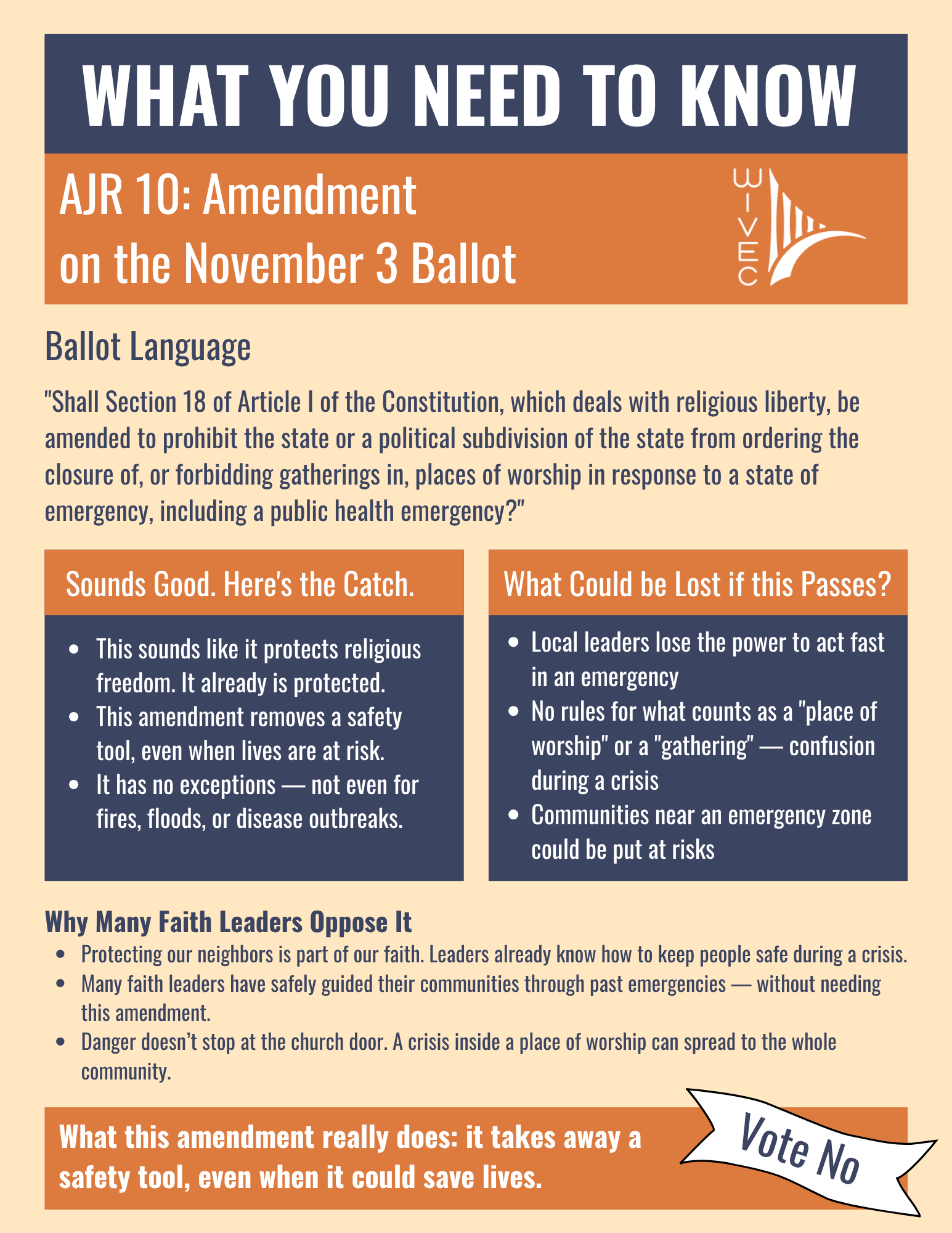
Question 2: Prohibiting State Government from closing religious sites during emergencies.
Ballot question: Shall section 18 of article I of the constitution, which deals with religious liberty, be amended to prohibit the state or a political subdivision of the state from ordering the closure of, or forbidding gatherings in, places of worship in response to a state of emergency, including a public health emergency?
Constitutional Amendment: [Article I] Section 18. The right of every person to worship Almighty God according to the dictates of conscience shall never be infringed; nor shall any person be compelled to attend, erect or support any place of worship, or to maintain any ministry, without consent; nor shall any control of, or interference with, the rights of conscience be permitted, or any preference be given by law to any religious establishments or modes of worship; nor shall any money be drawn from the treasury for the benefit of religious societies, or religious or theological seminaries; nor shall the state or a political subdivision of the state order the closure of or forbid gatherings in places of worship in response to a state of emergency at the national, state, or local level, including an emergency related to public health.
(a yes vote would add the underlined language to the constitution)
What does this mean?
What constitutes a state of emergency in Wisconsin?
Under Wisconsin Statute 323.10, the governor may issue an executive order declaring a state of emergency for the state or any portion of the state if they determine that an emergency from a disaster or an imminent threat of a disaster exists. The governor can also make the same determination for public health emergencies and can issue an executive order declaring a state of emergency related to public health. The governor is also authorized to designate the Department of Health Services as the lead state agency to respond to that emergency.
What does this order do?
● Responds directly to measures taken during the COVID-19 pandemic by Governor Tony Evers
● This would prevent the state government and any local division from closing or forbidding gatherings of places of worship in any state of emergency
● This prohibition includes all instances, including public health, natural disasters, or public safety emergencies.
● As a result, only the federal government would be able to take action in case of emergency.
Information from Senator Dora Drake, 4th Senate District
An Armenian Orthodox Perspective on Wisconsin’s Proposed Religious-Liberty Amendment
Written by Dr. Roberta Ervine and Dr. Ani Shahinian, St Nersess Armenian Seminary, Armonk, NY. 19 August 2026
Whether this amendment should appear on the ballot at all is questionable in a society where the separation of Church and State has long been taken for granted. However, since it is on the ballot, we offer the following thoughts for prayerful consideration by Wisconsin’s voters.
As an Oriental Orthodox Church with a particularly long history of living through catastrophic events and under changing political authorities, the Armenian Apostolic Church looks at the Proposed Religious-Liberty Amendment through the lens of a New Testament parable that describes the Church’s mission in times of personal or communal crisis.
For the Armenian fathers, the best depiction of the Church was the story of the Good Samaritan; the story that Jesus told to the young man who asked him, “Who is my neighbor?” Who is the person I should be caring for? And when should I care for that person?
We all have heard the story – how a man traveling on a narrow road was set upon by thieves, robbed, beaten and left for dead. How authority figures passed him by, thinking he was beyond help and how, finally, a member of the despised Samaritan community came to his aid, even though he could not speak to ask for help.
In the Armenian fathers’ understanding, Christ is himself the ultimate Good Samaritan, bending down to lift up the human race, beaten, bruised and robbed by sin and evil. Armenians are quite sure that the Church is the “inn” where the Samaritan took the wounded man and paid for his care until he himself could return.
Just in case the point of the story was unclear to the young man who asked, “Who is my neighbor?” Jesus told him – “Go and do the same, and you will live!” Thus, one Armenian church father commented, “He was setting down a law for the leaders of the church, that it is they who must become vigilant overseers and caregivers.”
If we close the inns — if we close our churches — where can those who have been spiritually wounded, morally robbed and heart-bruised by a crisis situation be brought for care? The question is not rhetorical.
Are there risks involved in caring for the spiritually bruised and vulnerable? Of course there are.
During the Armenian genocide in the early twentieth century, pastors knowingly accompanied their people on death marches, caring for their souls when care for their bodies was no longer possible. Many of those pastors never returned. During Armenia’s 2020 Artsakh war, clergy went to the front lines to bring sacramental encouragement to the men going out to fight; some of them fell side by side with the soldiers in the field. On September 9, 2001, the Armenian cathedral in Manhattan and churches in the surrounding area remained open, offering respite to first responders and a safe space to people fleeing the destruction or seeking loved ones. During the Covid pandemic, our churches were filled with people needing relief from fear, grief and anxiety. Crisis and emergency are where the Church belongs. Churches remind people of their connection with what lies beyond all crises. They hold our humanity even when its suffering is wordless.
Armenia’s 1700 years of Christian experience have taught us that human political authorities, no matter how good their intentions and how effective their programs, cannot address the heart-dimension of human suffering, let alone prevent it. They must pass by. The Church, however, cannot. It is the Church’s inn where the healing modalities of faith, peace, hope, moral responsibility, reconciliation, and prayerful connection to God are available to the vulnerable, at Christ’s expense.
Thus, in times of danger, isolation, illness, and loss, the governmental power to close places of worship removes an important source of support precisely when individuals and communities need it most.
In short, just as no city would close its hospitals in the midst of a pandemic, no state should close its churches in the face of a crisis. Until Christ’s return, it is the Church’s right, desire and sacred obligation to provide refuge, care and healing for all who find themselves at its doors, no matter what risks that may entail.

What does ELCA social teaching say?
ELCA social teaching emphasizes that God intends humans to work for the “common good” and says that the government is serving God’s purposes of justice and good order when it cares for the most vulnerable in society (Faith and Civic Life: Seeking the Well-being of All, p. 13-14 and p. 35).
The ELCA teaches that the government should not challenge a religious organization’s internal governance or religious decisions (Faith and Civic Life, p. 47). However, the ELCA emphasizes that religious interests must be balanced with public interests, including protection of others’ civil rights (Faith and Civic Life, p. 49).
We are responsible for the neighbor and should always act out of love, as exemplified by the life of Jesus Christ. That includes “giving of ourselves for the sake of others’ well-being, doing no harm, [and] promoting the well being of the neighbor” (Caring for Health: Our Shared Endeavor, p. 21). The church considers health to be a shared endeavor and teaches that caring for the health of others “expresses both love for our neighbor and responsibility for a just society (Caring for Health, p. 1). The church “holds that the free exercise of religion is not an absolute right and does not give faithful individuals or religious organizations license to harm” (Faith and Civic Life, p. 45-46).
Excerpt from: A Voter Guide from the Lutheran Office of Public Policy in Wisconsin
The Lutheran Office for Public Policy in Wisconsin (LOPPW) represents the coordinated public policy witness of the Evangelical Lutheran Church in America (ELCA) and engages Lutherans in advocacy for policies that promote peace, justice, and care for all of God’s creation. As Lutherans, we believe that God calls us to serve our neighbors and provides mercy, hope, and joy through Jesus Christ. See the entire voter guide here.
Position: Oppose