A Reachable Task: Getting Immigration Resources to People Held in the County Jail
How the Racine Interfaith Coalition worked with the Sheriff’s Office to reach people held on immigration holds — and how your county could do the same.

Imagine a person sitting in the Racine County Jail. They were booked on a criminal charge, like anyone else in the jail. But attached to their file is something most inmates do not have: a 48-hour immigration hold, requested by the Department of Homeland Security. When their criminal case ends — whether they are released on bond, complete a sentence, or have charges dropped — they will not simply walk out the door. The jail will hold them up to 48 additional hours so that Immigration and Customs Enforcement can take custody.
For that person, two entirely separate legal worlds have collided. And the ordinary supports our justice system provides are built for only one of them.
Why an immigration hold is a different kind of problem
A public defender can help with the criminal charge. That is what public defenders do, and they do it well. But a public defender is not an immigration attorney, and immigration law is a distinct, notoriously complex specialty. The person facing the hold often has no one to explain what comes next on the immigration side — and what comes next can move very fast. Someone taken into ICE custody may face expedited removal, with limited opportunity for a hearing before an immigration judge.
Geography compounds the problem. Racine County has no ICE detention facility. A person released from our jail into ICE custody may be transferred to a detention center far from home — hours away from family, from their attorney if they have one, from the community and faith networks that might otherwise stand with them. Families are left behind to absorb the shock and make wrenching arrangements: who will cover rent, who will care for the children, how a household holds together when one member has suddenly vanished into a system most people do not understand.
At the Racine Interfaith Coalition (RIC), we became aware of this situation through a quiet, ordinary source. Our county supervisors receive the jail’s daily population reports, and they share them with us. Month after month, those reports showed the same thing: a consistent presence of people held in the county jail on immigration holds. These were not abstractions. They were our neighbors, and the reports told us they were there.
The scale of the need extends far beyond one county. Wisconsin has 72 counties, and a jail in each one. If people are falling into this gap in Racine, they are almost certainly falling into it elsewhere. That is the reason we are telling this story: not because what we did was extraordinary, but because it was achievable — and it is repeatable.
Asking for the meeting
We decided the first step was simply to talk to the people who run the jail. We contacted the Sheriff’s Office and requested a meeting to ask a straightforward question: how could we help provide immigration resources to the people held there?
The meeting was not quick to arrange. It took persistence, and honestly, we cannot say for certain what finally moved the needle. What we can offer other groups is the full list of what we tried, so you can draw from it: alongside our direct request, we asked friendly county supervisors to voice support for the idea, and we asked local alders to do the same, quietly, behind the scenes. We suspect that this behind-the-scenes encouragement mattered as much as anything. If your group is waiting on a meeting that seems slow to come, our experience suggests that the relationships around the decision-maker are worth cultivating, not just the decision-maker themselves.
Eventually, we sat down in person with Chief Deputy James Weidner and his team.
Around the table
Four of us came from RIC, and the tone we set was cooperative from the first minute — because cooperation was genuine, not a tactic.
Linda Boyle, former RIC president and co-chair of the RIC Immigration Task Force, reminded the Sheriff’s team that our organizations had worked together before. That history mattered; we were not strangers making demands, but partners returning to a table we had shared in the past.
José (Rey) Palacios, a concerned community member, spoke to the human weight of the moment: the Latino community is under increasing pressure, and families need to be able to prepare if a loved one is facing deportation. Preparation is not resistance — it is the difference between a family that has time to arrange care and finances and one caught entirely off guard.
Fr. Yeprem Kelegian, former pastor of St. Mesrob Church, reinforced the spirit of cooperation and made our understanding explicit: we recognized that the people held in the jail were there on criminal charges, and that the immigration holds were a courtesy the department extended to ICE prior to release. We were not questioning the Sheriff’s lawful practices. We were asking how, within them, people could get information they had a right to.
Belinda Thielen explained the nature of our program. RIC’s Immigration Legal Services Initiative (ILSI) is a Department of Justice–recognized immigration services organization staffed by accredited representatives — and, as a recognized nonprofit, one that is not permitted to charge for the kind of help we were offering to make available. This was not a business proposition. It was a service.
The obstacle became the solution
The Sheriff’s team listened, and then they raised the practical wall that any group attempting this will likely meet: they did not see a workable way for us to connect face-to-face with people inside the jail who were on immigration holds. The logistics of in-person access to a specific subset of inmates were, understandably, a genuine problem.
That obstacle is where the good idea came from — and it came from their side of the table. The jail provides electronic tablets to inmates. Why not, the team suggested, place immigration resources directly on those tablets, where any inmate could reach them?
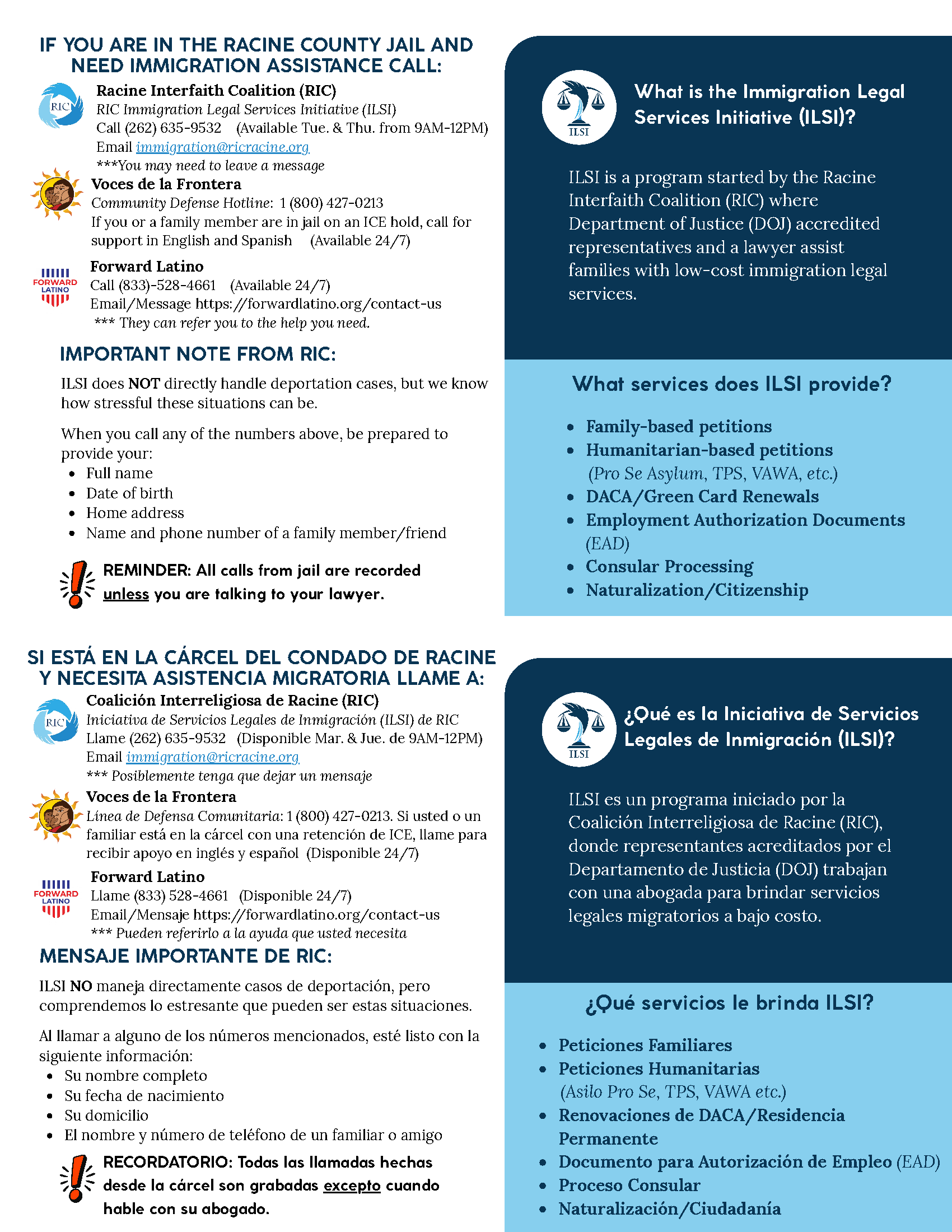
From there, the path was concrete. We submitted the American Bar Association’s “Know Your Rights” videos, produced specifically for immigration detention settings and available in English, Spanish, and French, to be loaded onto the tablets. Chief Deputy Weidner then invited us to include a PDF of local resources and contact information as well. We developed a one-page flyer built around the ILSI project and two statewide, around-the-clock hotlines — Voces de la Frontera and Forward Latino — that can connect a person or their family to the help they need. The final draft of that flyer went to the Sheriff’s Office in July.
What this means for your county
None of the steps above required special standing, a lawsuit, or a confrontation. They required a coalition willing to notice a need, a few relationships, the patience to wait out a slow calendar, and a posture of genuine cooperation with the people who run the jail. When we came in acknowledging what the Sheriff’s Office does lawfully and asking only how we could help within it, the department met us — and, in the end, offered the solution themselves.
There are 71 other counties in Wisconsin, and a jail in every one of them. In each, there are almost certainly people held on immigration holds, cut off from the specialized information they need at the most frightening moment of their lives. Reaching them is not beyond the capacity of an ordinary group of committed people. We know, because we are an ordinary group of committed people, and we did it.
If your congregation or coalition wants to take this on, we would be glad to share what we have learned. The Racine Interfaith Coalition can be contacted here: ricracine1993@gmail.com.